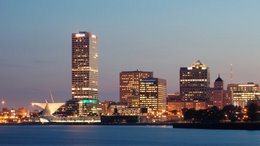
Showing posts with label downtown. Show all posts

Wednesday, July 22, 2009

New Milwaukee effort avoids the pitfall of recreating suburbs

It is an uphill battle to revitalize downtown retail in this economy, but Milwaukee’s downtown Business Improvement District is responding by hiring Deanna Inniss to recruit retailers to the city.

One may question why her list of tasks, as reported by the Journal Sentinel, does not include the troubled Shops of Grand Avenue on Wisconsin Ave., and why she does not plan to recruit big box stores. A glance into Minneapolis’ experience with downtown retail indicates there may be sound reasons for such an approach.

The Minneapolis equivalent of the Shops of Grand Avenue is a $150 million development called Block E. Completed in 2002 with $39 million in city subsidies, the retail and entertainment complex was to revitalize a key downtown block and lure suburban shoppers to the city center. It has some features that many in Milwaukee would envy: the light rail line is just a few blocks away, and its complex contains a hotel, a 15-screen movie theater, restaurants, an arcade, and a bowling alley. It is within one block of popular downtown sporting events, a main music venue, and many nightclubs.

The debate over how to best draw people from the suburbs to spend their time and money in Milwaukee's downtown has included arguments for similar investments here: a light rail line, some brand new development with substantial city investment, and anchor stores like a movie theater and arcade. But despite having all of those things in Minneapolis, the 30% vacancy in Milwaukee’s downtown mall ends up being an exact match for the projected vacancy in Block E.

Recent coverage about Block E in the Minneapolis Star Tribune included “Downtown complex gets a C for challenged,” “’E’ may stand for ‘emptier’,” and a columnist whose opinion was summed up in the headline as, “Block E: Let’s put it out of its misery.” Crime outside Block E is an issue, its Borders bookstore closed, its nightclub closed, and major tenant Sega Gameworks just announced it will sublease its space due to declining revenue. In addition, few buildings in Minneapolis have produced such outspoken hatred regarding architectural choices. Block E’s new construction has been referred to by columnist James Lileks, who advocates a full tear-down, as a “faux-historical façade … the architectural version of the elephant designed by a committee.” One online commenter called it "a suburban eyesore." The end result is that many downtown convention-goers bypass Block E in favor of taking light rail to the suburban Mall of America.

By focusing on recruiting small independent street retailers that are unique to downtown, Milwaukee's Business Improvement District may avoid some of the pitfalls experienced by Minneapolis. The more difficult question is posed in a Journal Sentinel editorial board blog post: "OK, but what to do about Grand Avenue Mall?" There appear to be no easy answers for that. Trying to create a suburban mall experience in a downtown setting has been problematic here and elsewhere; perhaps capitalizing on the diverse street-level hustle and bustle of city life could hold promise for Milwaukee’s downtown.

Wednesday, March 26, 2008

At least the Park East isn't a tunnel...

...according to a recent article in the Boston Globe.

When Milwaukee tore down the Park East Freeway in 2002, it was the first city to remove a downtown freeway overpass for purposes of what was then called urban revitalization.

Yes, San Francisco had replaced the Embarcadero freeway with surface development a decade earlier, but not as a result of planning--an earthquake had done the demolition. Portland had torn up its Harbor Drive highway in 1974 to create a waterfront park and Boston was in the midst of the Big Dig in 2002. But Milwaukee was unique in purposefully removing and not replacing a key piece of highway infrastructure; and for doing so for the sake of economic development, not green space.

Now other cities like Seattle and Toronto are looking at our experience as they debate removing their aging downtown freeways. When economic development is the purpose, should the surface streets be improved to accommodate the traffic or should the overpass be replaced by a tunnel?

Boston's over-budget, over-deadline “Big Dig” project has caused cities to shy away from similar tunnel plans, while our own Park East experiment is being touted as a planning success. That may be premature, however. The Globe article failed to mention that there is not yet a fully developed Park East business district to affect traffic. After McKinley Boulevard is carrying the volume of traffic for which it was designed may be a better time for other cities to judge whether surface streets or a tunnel is the best way to go in such situations.

Monday, April 2, 2007

Big in Japan

According to a recent The Wall Street Journal (WSJ) article, there are 92 skyscrapers under construction in Tokyo, Japan. Even at this pace of construction, it is reported that the supply of office space in Tokyo will not keep up with demand due to years of robust expansion in Japan's service sector.

With Milwaukee's downtown office vacancy rate hovering around a dismal 15%, it might be time to look to Japan for a quick lesson in downtown development.

The catalyst in Tokyo's office building boom, according to the WSJ article, is Japan's shift from a manufacturing economy to a high-end service economy built on marketing and finance jobs.

Milwaukee is going through a similar economic restructuring. But a recent report by The Brookings Institution highlights Milwaukee's inability to adequately replace lost manufacturing jobs with high-value service sector jobs. In other words, don't get caught up in the hype that blames Milwaukee's economic woes on manufacturing job losses. Instead, blame our economic malaise on the region's sluggish employment growth in its service economy (see below chart by Brookings).


The story is simple: Everyone is losing manufacturing jobs (yes, even China). Some regions are transitioning. Some are not.

Sure, we could subsidize developers in hopes of spurring new downtown construction. But, if the Tokyo boom teaches us anything, finding ways to bolster a high-end services economy may be a more efficient strategy in building a postcard-worthy skyline for Milwaukee's downtown.